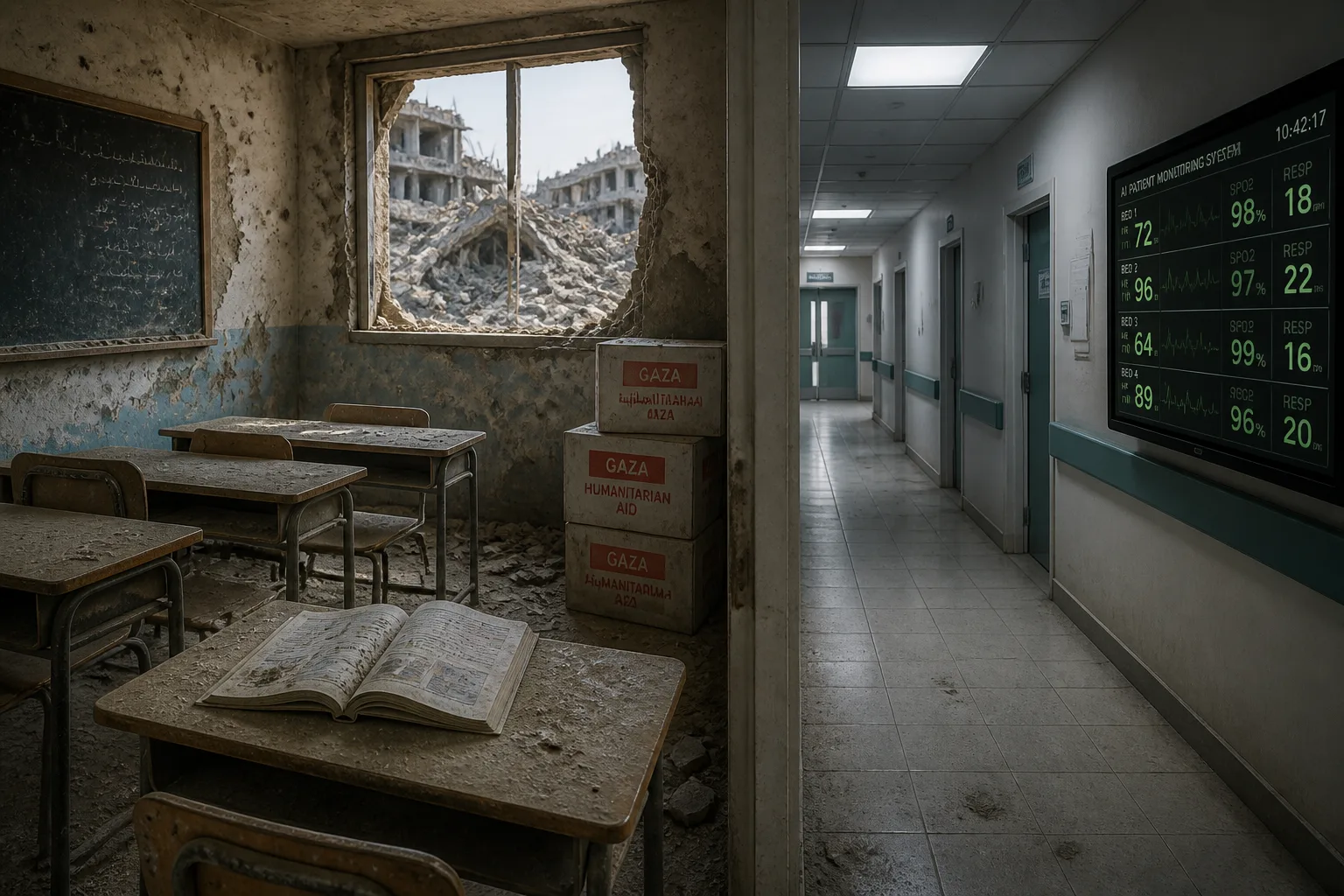
UN Highlights Escalating Education Crisis in West Bank, Calls for Aid in Gaza, While WHO Urges Responsible AI in Health
The United Nations has sounded a stark alarm, revealing that the West Bank’s classrooms are closing while Gaza’s displaced families are left hungry, and that the world must tighten its grip on AI in healthcare.
In a series of statements released on Tuesday, the UN’s Office for the Coordination of Humanitarian Affairs (OCHA) warned that access to education is deteriorating across the West Bank and that humanitarian aid for Gaza is falling short of the needs of displaced families.
OCHA’s latest figures show that the World Food Programme has already handed out food vouchers to nearly 300,000 people in the West Bank, but its stockpiles are running low and may run out before the next winter. Meanwhile, UNRWA schools remain a flashpoint.
For more than a year, six UNRWA schools have been inaccessible, and another six have been forced to close, according to UN spokesperson Stéphane Dujarric. In a briefing to reporters in New York, he highlighted that ten schools in Area C—a zone under full Israeli control that hosts the majority of Israeli settlements—have been abandoned after settler attacks and tightened access restrictions. Area C’s restrictions make it nearly impossible for Palestinian children to reach their classrooms.
In Gaza, the crisis takes a human face when a former UN school now shelters 18 displaced families. Suzanna Tkalec, the UN’s deputy humanitarian coordinator for the Occupied Palestinian Territory, led a joint humanitarian mission there on Wednesday. OCHA reports that the families’ living conditions have been undermined by a lack of access to humanitarian aid, and Dujarric reiterated that “our humanitarian partners are committed to mobilizing assistance to address the community’s most urgent needs.”
Humanitarian workers have been working around the clock amid ongoing Israeli military operations. In the past month, UN partner organizations have distributed more than 378,000 items—including tarpaulins, cleaning kits and jerrycans—to civilians in Gaza. In the West Bank, the WFP provided food vouchers and cash assistance to about 286,000 people in June. Dujarric warned that without additional funding, depleted stockpiles cannot be replenished, putting vulnerable families at greater risk as winter approaches.
The UN’s concerns arrived on the same day that the World Health Organization and the Government of Portugal opened a high‑level conference in Lisbon. Representatives from 37 countries across all six WHO regions gathered to discuss the responsible use of artificial intelligence in healthcare. An April WHO report found that 74 % of European Union member states already use AI to assist with diagnostics, but only 11 % have a health‑specific AI strategy and just eight % have liability standards for AI in case something goes wrong.
Dr Hans Kluge, WHO regional director for Europe, said the conference aimed to develop strategies that ensure patients with less access to healthcare and technology are not left behind as AI tools are adopted. He noted that patients are already using chatbots to ask about symptoms and that “regulating AI in health is hard, but not regulating it is harder – measured in patients harmed, trust lost and inequalities widened.” The WHO’s 2021 guidance on the ethical use of AI in healthcare remains a reference point for the discussions.
In a separate UN session, Human Rights Chief Volker Türk underscored that the transition to clean energy must not come at the expense of Indigenous Peoples’ rights. He cited that between 2023 and 2025, at least 15 % of human rights defenders killed or forcibly disappeared worldwide were Indigenous. Türk highlighted the case of Brooklyn Rivera, an Indigenous leader in Nicaragua who died in state custody in May, and called on Member States to respect Indigenous rights. He also mentioned a recent success in Australia, where an Indigenous group secured record compensation for mining conducted without their consent.
Türk urged Member States to support the UN Voluntary Fund for Indigenous Peoples and the Global Alliance for Human Rights, both of which strengthen Indigenous participation in international forums. He concluded that respecting Indigenous rights leads to a more just, peaceful and resilient society.
In short, the UN’s latest reports paint a grim picture: classrooms in the West Bank are closing, Gaza’s displaced families are hungry and under‑served, and the world must guard against the unchecked spread of AI in healthcare. At the same time, the UN reminds us that protecting Indigenous rights is an essential piece of the broader fight against inequality and vulnerability.