Chinas Sodium-Ion Battery Race Splits: CATL Drives EVs, BYD Targets Grid Storage
In a breakthrough that could redefine the future of electric mobility and grid stability, China’s battery giants have taken divergent paths in the sodium‑ion race.
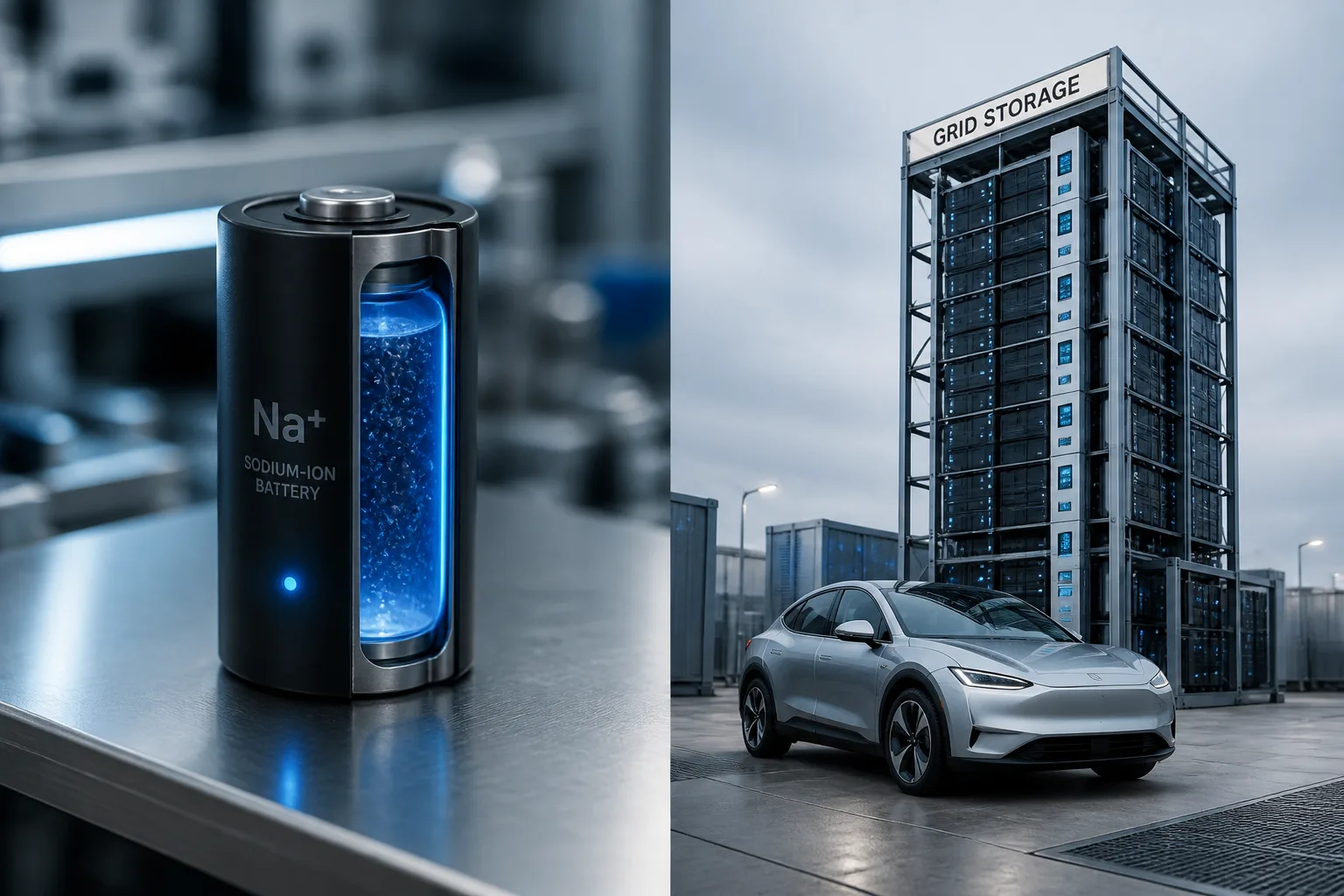
On June 15, 2026, CATL and its partner Changan Automobile rolled out the world’s first mass‑produced passenger vehicle powered by a 45‑kWh sodium‑ion pack. The launch marks a milestone: a sodium‑ion battery that can meet the weight, range, and safety demands of a production car. CATL’s move signals that the company is confident the chemistry can keep pace with the performance of its lithium‑ion counterparts.
At the same time, BYD is carving out a separate niche. Its third‑generation polyanion platform is aimed squarely at stationary energy‑storage systems. BYD’s long‑term target is a manufacturing cost of $0.04 per watt‑hour by 2027—an ambition that would bring sodium‑ion batteries into direct competition with lithium‑iron‑phosphate (LFP) cells in grid‑scale applications.
The company’s flagship product, the MC Cube‑SIB ESS container, is billed as the world’s first high‑performance sodium‑ion battery for grid energy storage. Using BYD’s patented Blade packing architecture, the 20‑foot container delivers 2.3 MWh of usable energy and operates at 1,200 V, with a voltage range of 800 V to 1,400 V. The research‑and‑development cells feeding the cube achieve 200 Ah capacity and more than 10,000 charge‑discharge cycles. Under standard grid cycling conditions, that cycle count translates to an estimated 33‑year operational lifespan.
A June 8 industry depth report from Minmetals Securities compared BYD’s polyanion chemistry with a layered‑oxide alternative. The polyanion cells exhibit a maximum thermal‑runaway temperature of 273.3 °C, compared with 484.5 °C for the layered‑oxide cells. They also evolve 93.1 L of gas under abuse, versus 123.3 L for the alternative. These metrics underscore the thermal safety advantage of BYD’s design—a critical factor for dense, indoor commercial energy‑storage installations.
The polyanion chemistry also tackles sodium‑precipitation and heat‑generation issues that have historically limited sodium‑ion cycle life. BYD’s cells can endure more than 10,000 cycles—roughly double the 2,000 to 3,000 cycles typical of LFP batteries used in EVs—while maintaining a lower thermal‑runaway temperature and reduced gas evolution.
Cost parity between scaled sodium‑ion production lines and established LFP lines is not expected until 2027. The delay is largely due to fragmented hard‑carbon anode supply chains and the absence of a standardized processing pathway. BYD’s focus on cost‑optimized materials for grid deployment is designed to bridge that gap.
Market projections reinforce the strategic split. The global sodium‑ion battery market is forecast to grow from $1.8 billion in 2025 to $12.5 billion by 2035. The grid‑storage segment is expected to hold 48 % of that market by 2035, giving BYD an early‑mover advantage in a rapidly expanding niche.
CATL leads the patent landscape with an 85 % share of sodium‑ion patents and is targeting EV applications through robust interface designs. BYD, in contrast, is concentrating on cost‑effective materials for grid deployment. The two companies are therefore operating in distinct niches rather than directly competing within the sodium‑ion space.
The divergence reflects each company’s broader strategy. CATL’s partnership with Changan Automobile and its focus on passenger‑vehicle batteries align with China’s aggressive push to electrify its automotive fleet. BYD’s emphasis on grid storage aligns with the country’s goal to integrate renewable energy into the national grid and to provide reliable backup power.
In short, the sodium‑ion battery landscape in China is bifurcated: CATL is advancing the technology for EVs, while BYD is building a cost‑competitive, safe, and long‑lasting solution for grid‑scale energy storage. As the market matures, the two approaches may converge, but for now they occupy complementary roles in the broader battery ecosystem.