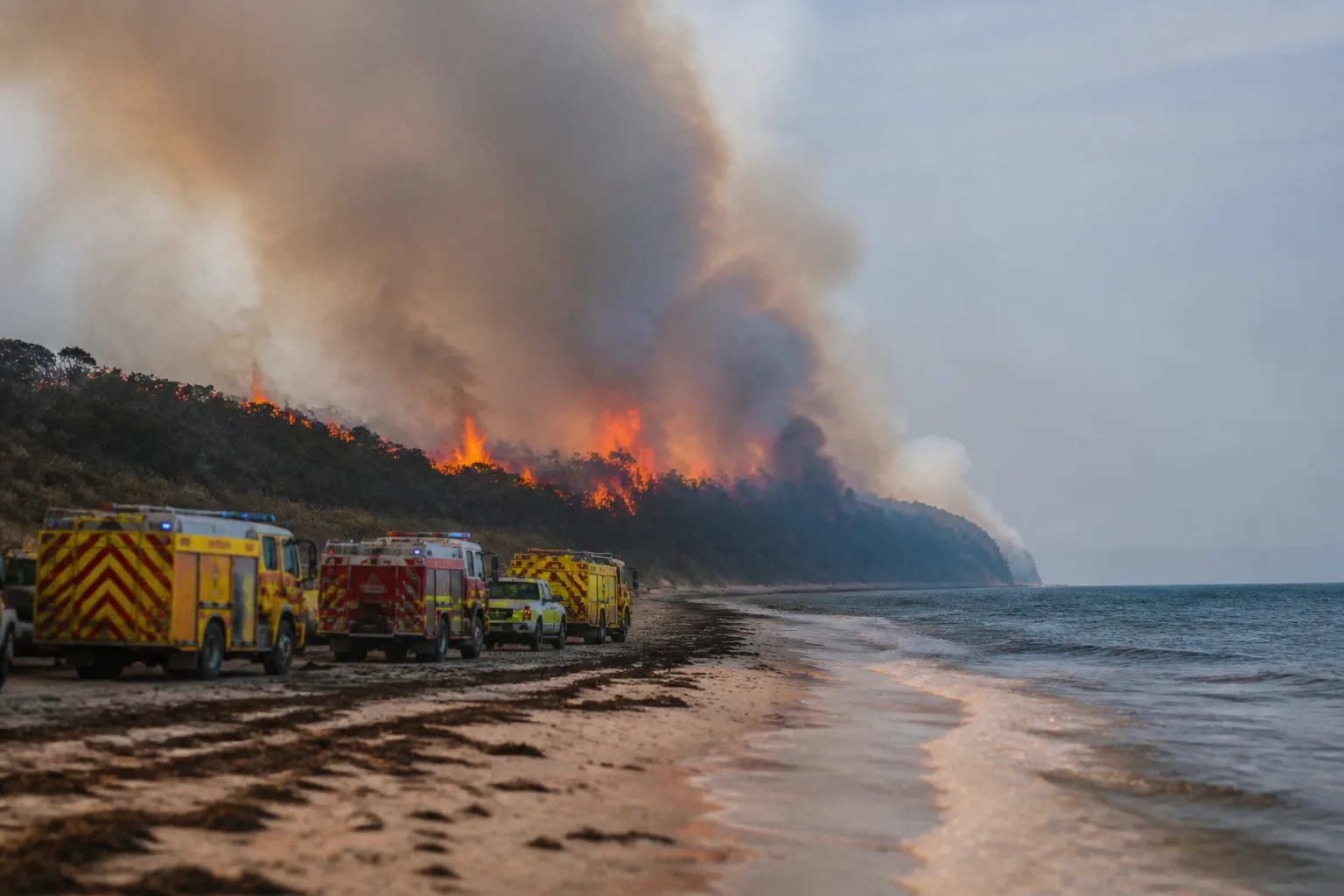
French Authorities Evacuate 4,000 More from Atlantic Coast as Wildfire Near Bordeaux Intensifies
French authorities on Tuesday announced that an additional 4,000 people must leave the popular tourist spots along the Atlantic coast, turning the blaze near Bordeaux into France’s largest peacetime evacuation yet.
The order follows a fresh flare‑up near Grand Crohot, a favorite beach on the Cap‑Ferret peninsula, and comes as a relentless heatwave threatens to erode firefighters’ gains. A fleet of 23 aircraft—18 fixed‑wing planes and five helicopters—was deployed to drop water and fire retardant on the newly ignited front. Gironde prefect Sophie Brocas warned that the situation remains complex and the fire still poses a danger. She also said that roughly 60,000 residents who had been evacuated earlier from Le Haillan, parts of Merignac and Eysines—areas outside Bordeaux’s ring road—could return on Tuesday. Those neighborhoods were free of active flames, but officials urged people to keep their phones on and emergency kits ready.
The blaze has already consumed an area four times the size of Paris and forced the displacement of 220,000 people. Interior Minister Laurent Nunez described it as “very likely” the largest civilian evacuation operation France has carried out outside wartime. In Le Porge, west of Bordeaux, the fire has destroyed about 150 homes. The inferno also produced a pyrocumulonimbus cloud—an unprecedented thunder‑cloud born from intense heat in France. The cloud unleashed lightning, violent winds and new fires beyond the original front, making containment even more difficult.
Heat warnings blanket Gironde. Météo‑France issued a yellow heat warning at midday, forecasting inland temperatures of 91 to 95 °F (33 to 35 °C). The broader heatwave has fueled wildfires across France and Spain. According to the Interior Ministry, 448 square miles (about 1,160 km²) have burned in France this year, affecting 115,000 hectares. Across Europe, roughly 330,000 people have been displaced by wildfires. Spanish authorities are already easing evacuation orders after firefighters made progress overnight, though several blazes—including Spain’s largest on record—remain uncontrolled.
Firefighting crews are also working hard to protect homes and create firebreaks. In Le Porge, municipal officials warned that smoldering vegetation, rising temperatures and falling humidity could spark fresh outbreaks along the fire’s perimeter. Military engineers and forest‑fire prevention crews resumed cutting firebreaks early Tuesday, completing 64 miles of new barriers. Prefecture reports indicate that at least 110 firefighters have been injured in the battle against the blaze.
The evacuation of 4,000 tourists from the Cap‑Ferret peninsula underscores how precarious the situation remains. While the prefecture urged visitors to stay away, some vacationers chose to stay. A family told Le Parisien that they went ahead with a $4,558 holiday, and another group debated abandoning a trip that had cost $741 each.
The combination of extreme heat, dry conditions and the pyrocumulonimbus phenomenon has made containment difficult. The fire’s rapid spread and the need for large‑scale evacuations highlight the growing risk of wildfires in Western Europe, where temperatures are rising faster than the global average.
As the heatwave continues, French authorities will monitor the situation closely and may issue further evacuation orders if conditions worsen. Residents in the affected areas are advised to stay informed through local news and official channels.
The current state of the fire remains uncertain, but the authorities are maintaining a broad strategy of containment, evacuation, and public safety measures to protect both residents and visitors.