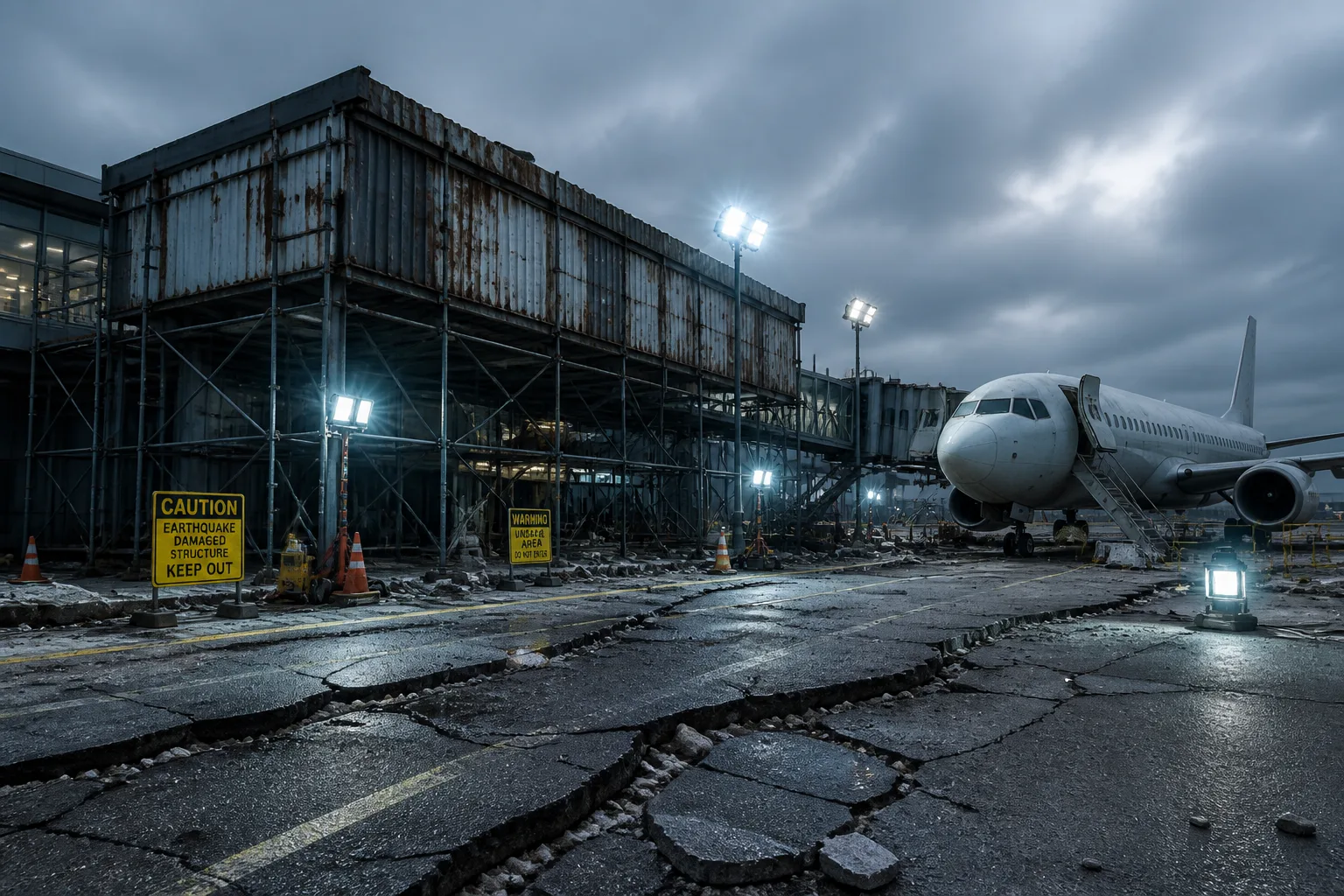
Simon Bolivar Airport Reopens After Earthquake-Damaged Temporary Terminal
Simón Bolívar International Airport in Venezuela has partially reopened after a temporary terminal was erected in its parking lot, marking the first commercial flights back to the capital since the twin earthquakes of June 24, 2026. The temporary structure, covering roughly 10,000 square meters, can handle 2,168 passengers per day and includes check‑in counters, air‑conditioned waiting areas, free Wi‑Fi, medical services and restrooms. Passengers are transported by bus between the temporary terminal and the aircraft. The reopening is a step toward restoring the airport’s pre‑earthquake capacity, officials say, and will initially support seven domestic and four international round‑trip flights operated by Copa Airlines and Air Europa, with Iberia expected to join soon.
The airport, located in Maiquetía in La Guaira state about 20 kilometres north of Caracas, was closed after severe damage to its runways, control tower and passenger and cargo boarding buildings during the 7.2 and 7.5 magnitude earthquakes of June 24. Those shocks left more than 6,500 people dead and some 17,900 homeless. The temporary metal structure was built in the airport’s parking lot and was certified by international inspectors.
According to the airport, the temporary terminal’s 10,000 square‑metre footprint can handle 2,168 passengers per day. It contains check‑in counters, air‑conditioned waiting areas, free Wi‑Fi, medical services and restrooms. Passengers are moved by bus between the terminal and their aircraft.
“We hope that with this initial phase of operations … we will recover 25% of the operations we had before the earthquake,” Transportation Minister Francisco Garcés told the press Tuesday. He added that “we will gradually create the conditions to increase these capacities,” reaching 40% in a few months and 60% by the end of the year or beginning of next year. Garcés said that the resumption of operations has been certified by international organizations that carried out the corresponding inspection.
The resumption of commercial operations will initially include seven domestic and four international round‑trip flights operated by Copa Airlines of Panama and Air Europa of Spain. Other airlines, including Spain’s Iberia, will be added in the coming days.
Until Monday, all international flights arrived at small airports in the central state of Carabobo and the eastern state of Anzoátegui, approximately 168 kilometres and 314 kilometres from Caracas, respectively.
The earthquakes were the strongest recorded in Venezuela in over a century and occurred 39 seconds apart along the coastal mountain range, where the country’s largest population centres are located. The tremors caused severe damage in Caracas and the central‑western states of Carabobo, Miranda, Aragua and Yaracuy. Most of the deaths occurred in La Guaira, Venezuela’s second‑smallest state, which is home to Simón Bolívar International Airport and the country’s second‑largest port. Its population of 440,000 is mostly made up of poor residents who rely on tourism, commerce and activities related to the airport and port.
The airport’s reopening is a tangible sign of recovery for a region that suffered extensive damage. While the temporary terminal can only handle a fraction of the airport’s pre‑earthquake traffic, it allows passengers to return to the capital and provides a foundation for future expansion as repairs continue.
The temporary terminal’s limited capacity means that the airport will not be able to handle the full volume of flights it previously managed. However, the ability to operate flights again is a critical step for the local economy and for the millions of people who rely on air travel to connect with the rest of the country and the world.
The reopening also signals that international partners are willing to support Venezuela’s infrastructure recovery. The certification by international inspectors underscores that the temporary facilities meet safety standards, giving airlines and passengers confidence in the airport’s operations.
In the coming weeks, the airport will likely expand its services as repairs to runways and other critical infrastructure progress. The government has outlined a phased approach to increase capacity to 40% in a few months and 60% by the end of the year or early next year, according to Minister Garcés.
The reopening of Simón Bolívar International Airport is a milestone in Venezuela’s post‑earthquake recovery, offering a glimpse of normalcy for a country that has faced significant challenges in the past year.