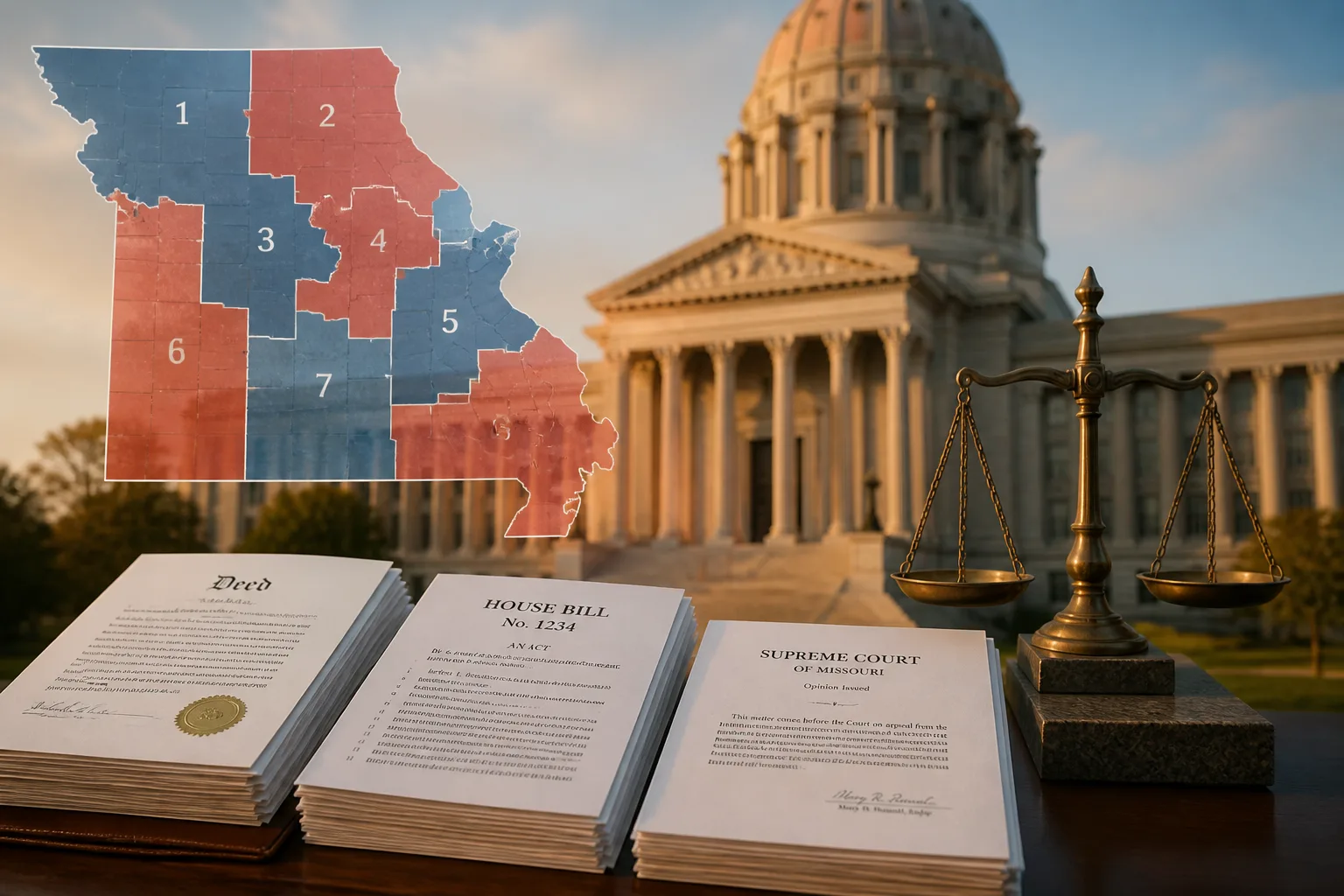
Missouri Supreme Court Orders Secretary of State to Explain Use of Contested Congressional Map
Missouri’s political map is at the center of a courtroom standoff that could reshape the state’s congressional delegation. In a late‑night decision on Tuesday, the Missouri Supreme Court told Republican Secretary of State Denny Hoskins to appear in person on Thursday and explain why he should not be held in contempt for directing election officials to use a congressional map the court has barred him from implementing.
The order gives Hoskins until noon Wednesday to answer a motion for contempt filed by the political action committee People Not Politicians. The committee, which pushed a referendum on a 2025 map that heavily favors Republicans, is now demanding that Hoskins justify his actions. A hearing is set for 10 a.m. Thursday.
The contempt fight erupted after U.S. Supreme Court Justice Brett Kavanaugh denied Missouri officials an emergency request to stay the state‑court ruling. Minutes later, Chief U.S. District Judge Stephen Clark issued a temporary restraining order that bars Hoskins from using any congressional map other than the 2025 version. In response, Hoskins sent local election officials a copy of Clark’s order and his certification of the November ballot, asserting that Clark’s order “takes precedence over the Missouri Supreme Court’s order.”
On Thursday, the state’s highest court reversed course: it ruled that the referendum on the 2025 map was legal, sufficient, and timely, and ordered it onto the November 3 ballot. Because the petition was filed before the new map took effect, the court held that the 2025 districts never became law. The map used in 2022 and 2024 therefore remains in effect for the November election.
But the court also permanently enjoined Hoskins and anyone acting with him from implementing or using the 2025 map unless voters approve it in November. Chief Justice W. Brent Powell directed Hoskins to answer three specific questions:
1. Why his e‑mail on September 8, 2026, instructing use of the 2025 map is not an affirmative violation of the court’s injunction; 2. How the court’s injunction is not still in full force and effect in light of the Supreme Court’s overruling of the state’s emergency application for stay; 3. If he is not willing to comply, he should take no action related to the congressional district map until guidance is received from a higher court.
Powell also instructed the court not to allow filings from any other parties on this matter.
Attorney Chuck Hatfield, who represents People Not Politicians, pointed out that both the Missouri Supreme Court’s order and Judge Clark’s order are in effect, leaving election authorities without a clear map to use. Hatfield argued that by directing local election officials to implement the 2025 map, Hoskins is violating the court’s orders. He urged the court to make it clear that, except for orders from the U.S. Supreme Court, the Secretary of State must comply with the state court’s injunction.
Judge Clark’s action came after a lawsuit filed on Friday by U.S. Rep. Bob Onder, state Sen. Rick Brattin, and two voters. They want to keep the 2025 map in place, which shifts territory around Onder’s home into the 3rd District and redraws the 5th District to favor Republicans.
The conflicting orders created immediate confusion. Attorney General Catherine Hanaway issued a news release saying the state would comply with Clark’s order. Attorneys for People Not Politicians warned that the conflicting orders could leave election officials unsure which one they must follow.
A referendum on the 2025 redistricting plan will appear on the November 3 ballot as Proposition A. The 2025 map was drawn to make seven of Missouri’s eight congressional districts favorable to Republicans, mainly by reshaping the Kansas City‑based 5th District held by Democratic U.S. Rep. Emanuel Cleaver. The map used in 2022 and 2024 produced a delegation of six Republicans and two Democrats.
Clark wrote that without a temporary restraining order, many Missouri voters would have to cast general‑election votes for candidates they had no role in nominating. He also found that the public interest favors using the same map for the primary and general elections, arguing that disenfranchising voters and denying them their constitutional right to have their primary votes counted would significantly harm the public interest.
The heart of both Clark’s ruling and the appeal to Kavanaugh lies in the Missouri Supreme Court’s decision to enjoin Hoskins from using the gerrymandered congressional map. Kavanaugh did not elaborate on his decision. The court’s denial of the state’s emergency application for stay left the state court order in place and the 2022 map in effect for the November election.
The situation remains unresolved as the state court, federal court, and the Secretary of State prepare to address the conflicting orders and the upcoming referendum.