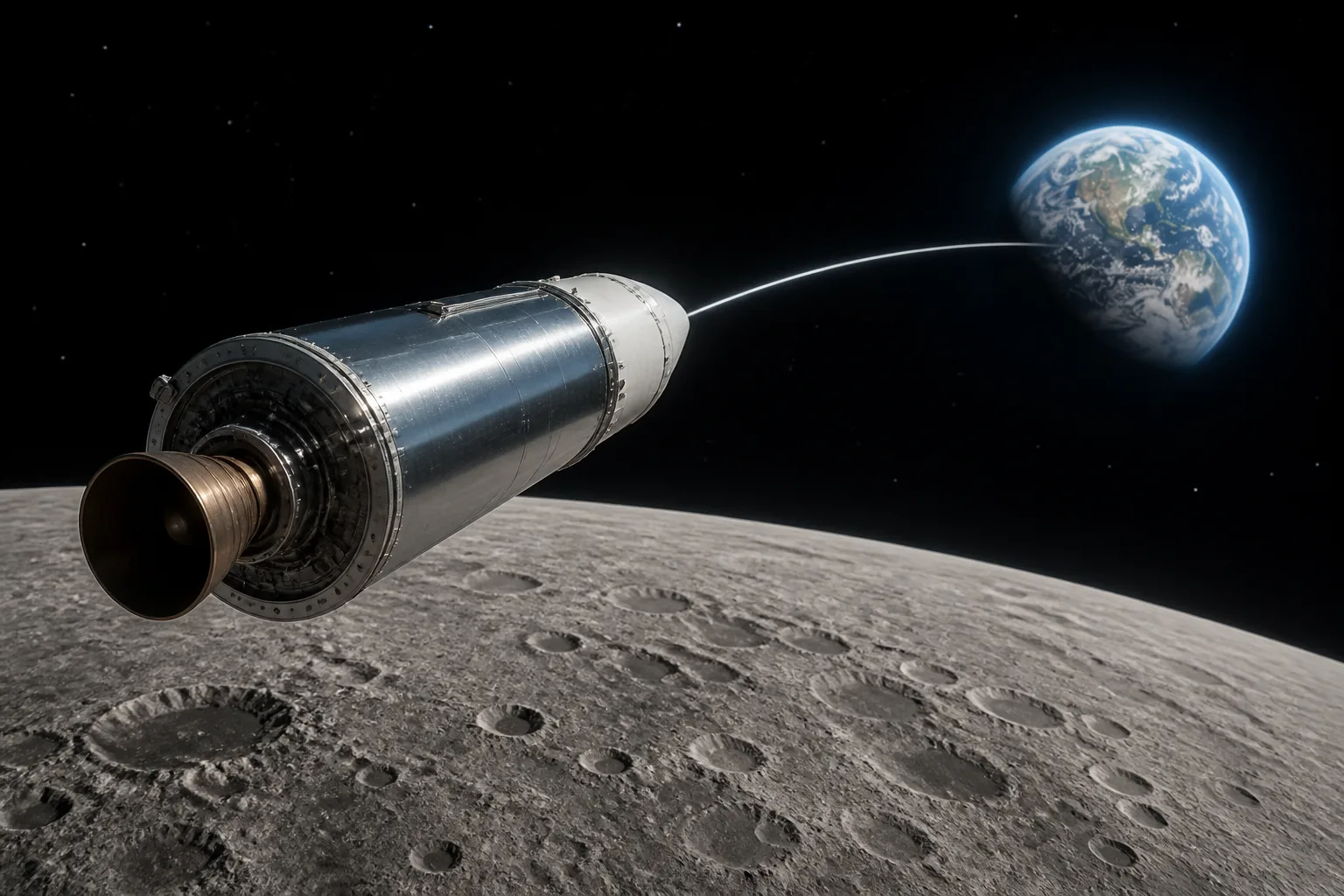
SpaceX Falcon 9 Upper Stage to Crash into Moon on Aug. 5, 2026
On the morning of Aug. 5, 2026, a forgotten piece of a SpaceX launch will pay its respects to the Moon. A discarded upper stage of a Falcon 9 rocket is set to collide with the lunar surface near the Einstein crater on the Moon’s western limb, roughly at 06:35 UTC—give or take a few minutes. The impact will unleash an energy burst equivalent to about three tons of TNT.
The stage in question was launched on Jan. 15, 2025, as part of a dual‑rover mission that delivered Blue Ghost‑1 and Hakuto‑R Mission 2 to the Moon. After its primary work was done, the 4‑tonne upper stage was left in a heliocentric orbit. NASA’s Center for Near‑Earth Object Studies (CNEOS) has calculated that this orbit will intersect the Moon’s path on the scheduled date.
At impact the stage will zip across the lunar sky at roughly 5,400 mph (8,700 km/h). The collision is expected to gouge an 18‑metre (59‑ft) wide, 4‑metre (13‑ft) deep crater. Lunar regolith will be hurled into a plume that could rise up to 100 km (62 mi) above the surface, spreading laterally about 114 mi (183 km). The plume will feature a central spike that may soar 47–60 mi (75–100 km) above the Moon.
The event will be visible from Earth. A brief fireball produced by the impact could be seen with a telescope from the eastern United States and much of South America. Sensitive instruments on lunar orbiters—such as NASA’s Lunar Reconnaissance Orbiter and South Korea’s Danuri satellite—should also pick up the high‑altitude dust cloud.
Scientists view this collision as a rare laboratory for studying impact physics on the Moon. Because the mass, velocity, and trajectory of the stage are known ahead of time, researchers can compare observations with theoretical models of ejecta dynamics and crater formation. The data will help refine estimates of how small impacts alter the lunar surface, information that is crucial for future missions that will land or operate near the Moon’s western limb.
The incident also underscores the growing issue of space debris. While the stage poses no immediate threat to Earth‑orbiting satellites, its presence in lunar orbit and eventual impact raise questions about long‑term lunar surface contamination and the need for clearer space‑law guidelines regarding the disposal of spent rocket stages.
In short, the Aug. 5 impact will provide a live demonstration of a human‑made object striking the Moon, offering valuable scientific data and prompting renewed discussion about responsible space operations.