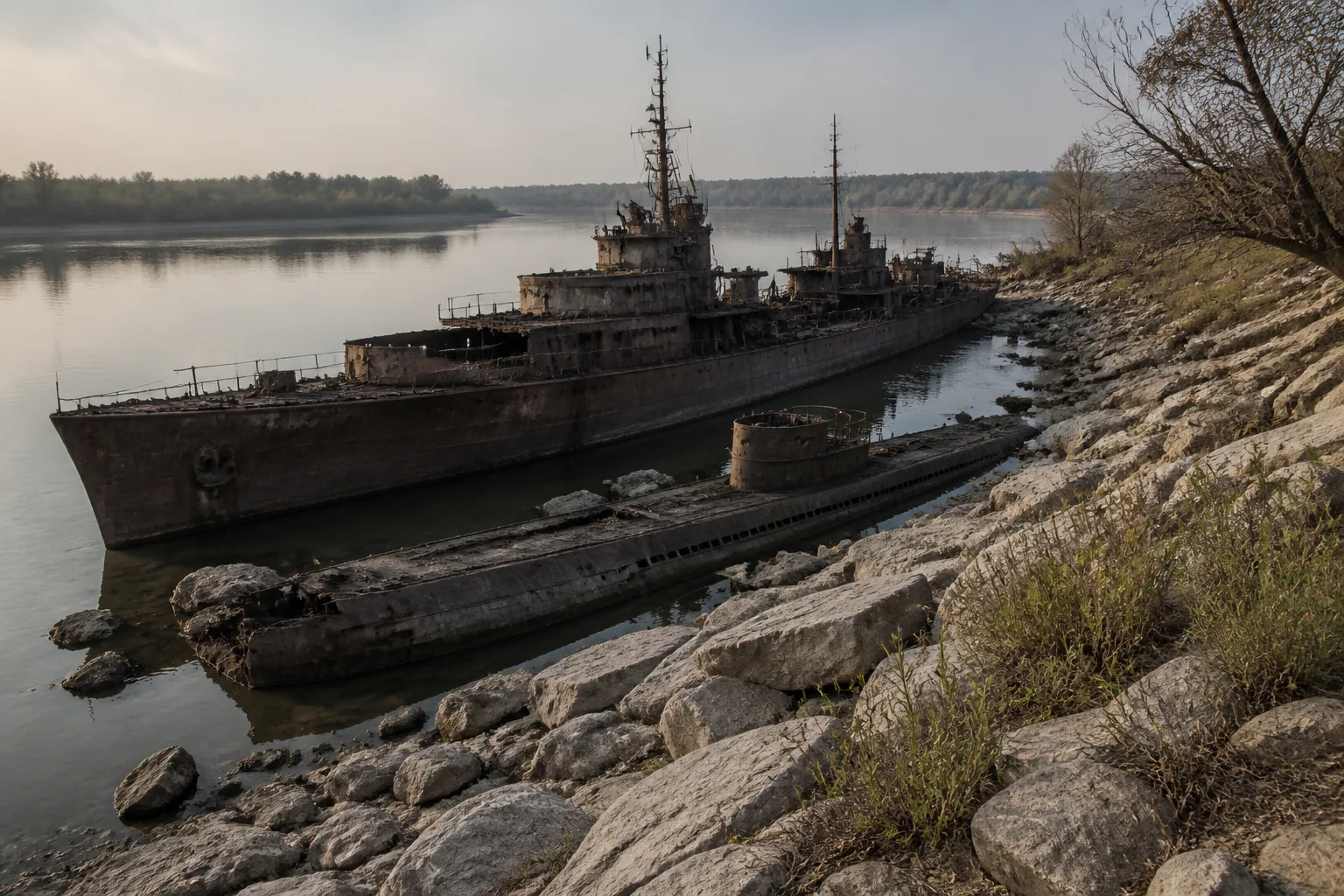
Low Danube Levels Expose Dozens of WWII German Warships Near Serbias Prahovo
When the Danube’s waters recede, history rises from the riverbed. A prolonged drought that has gripped Central and Eastern Europe has pushed the water level to historic lows, revealing the hulks of dozens of German warships that were scuttled there in World War II.
The Danube, Europe’s second‑longest river, spans 2,850 km from the Black Forest in Germany to the Black Sea. It snakes through or borders ten countries—Austria, Slovakia, Hungary, Croatia, Serbia, Romania, Bulgaria, Moldova, and Ukraine—and 2,415 km of its course remain navigable, making it a vital artery for hydropower, drinking water, and commercial transport.
In September 1944, as Soviet forces pressed into the Balkans, Nazi Germany deliberately sank up to 200 ships of its Black Sea fleet in the Danube gorge near Prahovo. Ordered by Rear Admiral Paul‑Willy Zieb, the scuttling aimed to block the river and stall the Soviet advance. The vessels were left largely intact, many still bearing weapons and explosives.
After the war, the Communist Yugoslav authorities removed a handful of wrecks, but most stayed because the unexploded munitions posed a danger. The hulks have since become a hidden hazard, lurking beneath the river’s surface.
Today’s drought has lowered the water to a point where the river’s banks are exposed and the warships are visible. The low flow has also forced power plants that rely on the Danube for cooling to the brink of shutting down, and it has disrupted shipping traffic. Local residents report that large vessels can no longer pass.
"As you can see, the (big) ships can't pass anymore," said Krsta Brandic, a resident of Prahovo.
Serbian and Romanian officials are working to keep the Danube navigable. The reduced depth creates dangerous conditions for vessels, and authorities are monitoring the situation closely. Experts link the drought to broader climate trends, noting that unusually hot weather and a lack of rainfall are contributing factors.
The exposed warships have drawn international attention. Beyond the immediate safety concerns, the sighting serves as a stark reminder of the region’s wartime history. The ships’ presence in the Danube’s current path is a physical legacy of the conflict that shaped modern Eastern Europe.
The situation also underscores the Danube’s vulnerability to climate change. As water levels continue to fall, the river’s role as a transportation artery and a source of hydroelectric power is increasingly at risk.
For now, the Danube’s low water level has turned the river into a living museum of wartime history, while simultaneously threatening the economic and energy stability of the countries it traverses.
Authorities are monitoring the river’s depth and the condition of the exposed wrecks, coordinating with neighboring countries to manage potential hazards to navigation and power generation.
The Danube’s current state highlights the intersection of historical legacy and contemporary environmental challenges, reminding observers that the past can surface in unexpected ways when present conditions change.