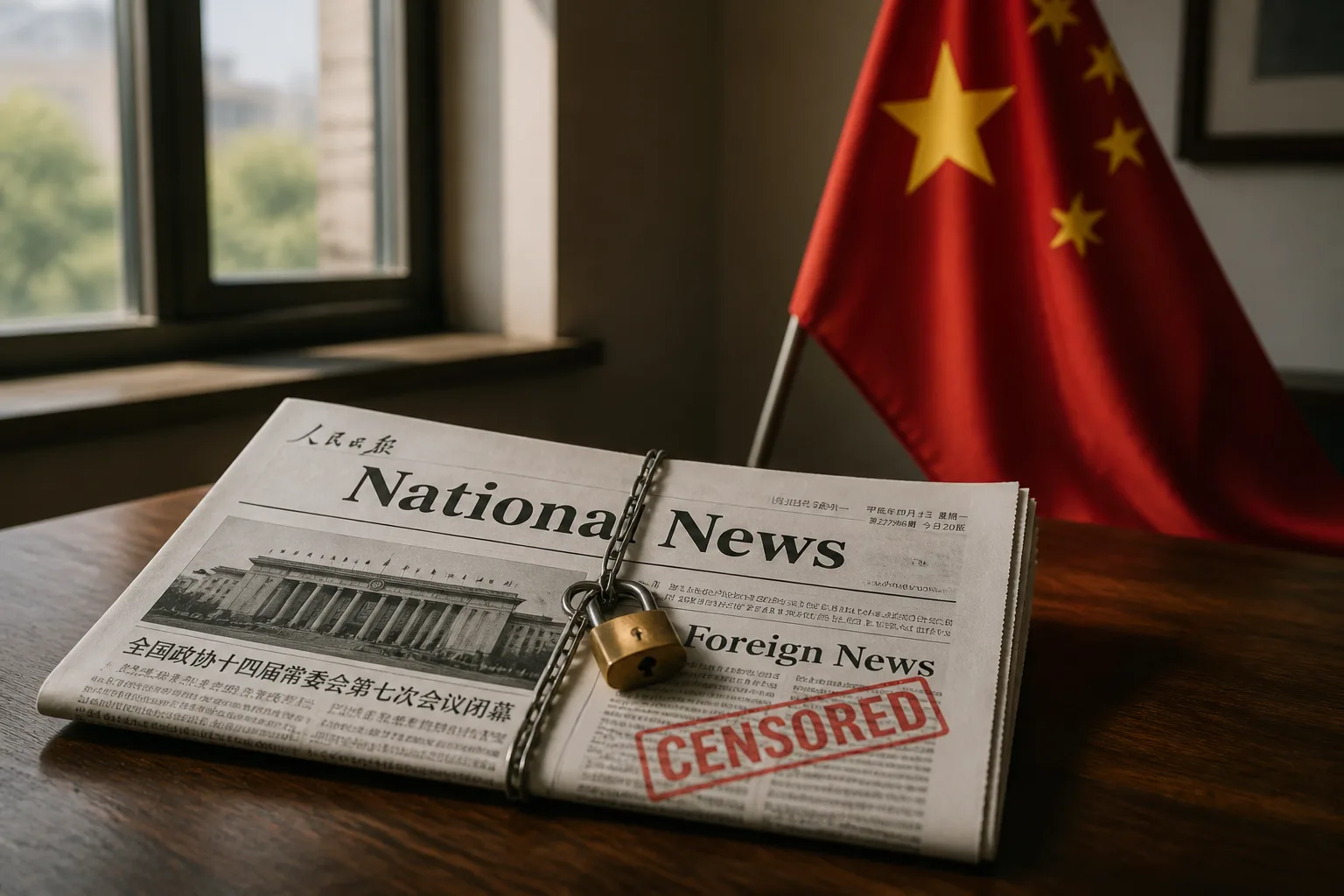
Study Finds Chinese Communist Party Tightens Foreign News Coverage in Peoples Daily Under Xi Jinping
If you think the People’s Daily has always been the Chinese Communist Party’s official voice, a new study suggests the paper is tightening that voice even more. Published in the Journal of Contemporary China, the research shows that foreign news stories in the nation’s flagship daily have shrunk since Xi Jinping took office in 2013. By combing through more than one million articles from 1993 to 2022, the authors found a clear shift: reporting on events outside China gave way to editorial pieces that echo party lines.
The People’s Daily, founded in 1948, has long been dubbed the party’s “newspaper of record.” Its pages are a direct conduit from the Central Committee’s Publicity Department to readers, ensuring that domestic opinion aligns with party directives. The paper’s editorial and news functions are tightly controlled, making it a barometer of CCP messaging.
The study, titled “Domestic Politics and Editorial Control Over Foreign News Coverage in the People’s Daily, 1993–2022,” was a collaboration between scholars Jack Zhang of the University of Kansas, Jianbing Li of the University of Hong Kong, Duoji Jiang of the University of Chicago, and Weifeng Zhong of George Mason University. Zhang said the team had expected foreign coverage to grow as China’s global role expanded, but the data told a different story.
Key findings include: first, an overall reduction in foreign news—articles on events outside China fell during Xi’s first and second terms. Second, a shift toward editorial content—the proportion of pieces carrying the party’s viewpoint rose, while factual reporting, human‑interest stories, and coverage of foreign leaders’ statements dipped. Third, greater consolidation of media control—Zhang noted that Xi’s second term has a stronger effect on editorial direction than earlier periods. Finally, while the volume remains high, the narrative is tighter: the paper still publishes a large amount of foreign coverage, but it is more tightly aligned with party messaging.
Zhang argues that the change reflects the CCP’s desire to harmonize competing elite perspectives on issues such as U.S. relations and economic openness. In the United States, government influence on media is indirect, whereas in China the party’s direct control over the People’s Daily allows it to craft a unified message. The study highlights that the paper, though a key propaganda tool, faces the same economic and cultural challenges as other print outlets.
China’s growing consumption of TV news and social media is shifting audiences away from print, yet the People’s Daily remains a reference point for other propaganda workers. The research underscores how the CCP’s tightening grip on media content coincides with Xi Jinping’s broader consolidation of power. It also illustrates that the party’s focus is not on reducing international coverage per se, but on controlling the narrative presented to Chinese readers.
Published in the Journal of Contemporary China, the study is part of a broader effort to understand how domestic politics shape media output in authoritarian contexts. The People’s Daily continues to be the primary source for Chinese officials and the public on domestic and international affairs, and its editorial direction will likely remain a barometer of the CCP’s communication strategy.